A practical local SEO checklist for small businesses helps you appear when nearby customers search Google for the products or services you offer. Instead of relying solely on word-of-mouth or paid ads, local search engine optimization puts your business in front of people actively looking to call, visit, or request a quote right now.
Whether you run a dental clinic, café, salon, coaching institute, repair service, or B2B office, showing up in Google’s Local Pack and organic results builds immediate credibility. Best of all, local search traffic compounds over time without paying for every single click.
In this complete guide, we walk through a nine-step local SEO checklist for small businesses that you can follow systematically to improve Google Maps visibility, attract qualified local enquiries, and turn searchers into paying customers.

Why a Local SEO Checklist for Small Businesses Matters
When someone searches for a service near them—such as “digital marketing agency near me” or “best physiotherapist in South Delhi”—Google displays a map with three top business listings followed by standard organic website results.
If your business does not appear in those top local results, nearby buyers choose your competitors before they even know you exist. Having a clear local SEO checklist for small businesses ensures you do not miss foundational signals that Google uses to evaluate relevance, distance, and prominence.
Local SEO also works hand in hand with your broader online presence. Even if someone discovers your brand on Instagram or through Meta Ads for local businesses, they often search your business name on Google to check reviews, directions, and your website before reaching out.
Quick Summary: The 9-Step Local SEO Priority Matrix
Before diving into the step-by-step instructions, use the priority table below to see where each item in our local SEO checklist for small businesses sits in terms of impact and ongoing effort.
| Step | Focus Area | Primary Impact | Frequency |
|---|---|---|---|
| 1 | Google Business Profile Optimization | Google Maps Pack Rankings | Setup + Weekly Updates |
| 2 | NAP Consistency & Local Citations | Trust & Location Verification | Setup + Quarterly Audit |
| 3 | Local Keyword Research | Search Intent Alignment | Quarterly Refresh |
| 4 | Location & Service Landing Pages | Organic Local Rankings | One-Time + Expansion |
| 5 | On-Page SEO Elements | Crawlability & Click-Through Rate | Every Page & Post |
| 6 | Customer Reviews & Responses | Conversions & Prominence | Weekly Ongoing |
| 7 | Local Schema Markup | Rich Search Understanding | Setup + Template Check |
| 8 | Mobile Speed & Core UX | Bounce Reduction & Calls | Monthly Monitoring |
| 9 | Local Link Building & Tracking | Domain Authority & ROI Proof | Monthly Ongoing |
1. Claim and Fully Optimize Your Google Business Profile
Your Google Business Profile (GBP) is the single highest-leverage asset in any local SEO checklist for small businesses. It powers your appearance on Google Maps and the Local 3-Pack directly inside search results.
Start by claiming and verifying your listing through the official Google Business Profile Help portal. Once verified, complete every single field accurately rather than leaving sections half-finished.
Essential Google Business Profile Action Items
- Use your real business name: Match your storefront signage and legal documents. Avoid stuffing extra city names or keywords into the business title, as this violates Google guidelines and risks suspension.
- Select the most accurate primary category: Your primary category strongly influences which searches trigger your profile. Add relevant secondary categories only for services you genuinely provide.
- Set exact service areas and business hours: Update holiday hours in advance so customers never arrive at a closed door or lose trust.
- List individual services with clear descriptions: Add each core service and brief pricing or scope context where appropriate.
- Upload real, high-resolution photos: Add exterior photos, interior workspace shots, team images, and completed project examples.
- Publish Google Posts weekly: Share offers, tips, new blog guides, or event announcements to keep your profile active.
Treat your Google Business Profile like a mini-homepage. An active, complete profile is the fastest win inside any local SEO checklist for small businesses because it gives searchers confidence to tap the “Call” or “Website” button immediately.

2. Audit NAP Consistency Across Local Directories
NAP stands for Name, Address, and Phone Number. Search engines cross-check your business details across the web to confirm that your location and contact information are legitimate.
If one directory lists an old phone number while your website shows a new mobile number—or if your street address is abbreviated differently across platforms—search engines become less confident in your data. That is why citation cleanup is a core step in a reliable local SEO checklist for small businesses.
How to Standardize Your Citations
- Create one master NAP document: Write down the exact spelling, punctuation, suite or floor number, PIN code, primary phone number, and website URL you will use everywhere.
- Match your website footer and contact page: Ensure your contact page displays the exact same NAP format as your Google Business Profile.
- Update major business directories: Check platforms relevant to your region and industry, such as Bing Places, Apple Business Connect, Justdial, Sulekha, IndiaMART, Clutch, or local chamber listings.
- Remove duplicate listings: Merge or request removal of outdated profiles created by past employees or automated scrapers.
You do not need hundreds of low-quality directory links. Focus on clean, accurate listings on trusted platforms that real customers actually browse—every verified citation strengthens the foundation of your local SEO checklist for small businesses.
3. Research High-Intent Local Keywords
Many small business websites fail to rank because they target broad, generic terms instead of the specific phrases local buyers type when they are ready to hire.
Effective keyword research inside a local SEO checklist for small businesses separates informational searches from commercial local queries. A user searching “what is teeth whitening” is researching, while someone searching “teeth whitening clinic in Noida” is ready to book an appointment.
Three Types of Local Keywords to Target
- Service + City or Neighbourhood: Examples include “interior designer in Gurgaon,” “tax consultant in South Delhi,” or “digital marketing agency in Delhi NCR.”
- “Near Me” and Proximity Modifiers: Phrases such as “AC repair near me” or “cafe open now” rely heavily on strong Google Business Profile signals and mobile friendliness.
- Problem-Focused Local Queries: Long-tail searches like “best digital marketing strategy for small shops in Delhi” work well for educational blog posts that build trust and link to your core service pages.
Use Google’s autocomplete suggestions, “People also ask” boxes, and Google Search Console query reports to discover the exact wording your local customers use, and update your local SEO checklist for small businesses keyword list every quarter.
4. Build Dedicated Service and Location Pages
Trying to rank your homepage for ten different services across five different neighbourhoods rarely works well. Search engines prefer focused pages where one page clearly answers one primary user intent.
If your business does not yet have structured service pages—or if you are still wondering whether businesses need a website alongside social profiles—dedicated landing pages are a critical pillar of a local SEO checklist for small businesses.
What Every Local Service Page Should Include
- A clear H1 headline: State the service and location naturally so visitors know within three seconds that you serve their area.
- Detailed service breakdown: Explain what is included, who it is for, and how your process works.
- Local proof points: Mention specific neighbourhoods or landmarks you serve, genuine customer testimonials, and photos of your work.
- Visible conversion actions: Place click-to-call buttons, WhatsApp links, and a short enquiry form above the fold and at the bottom of the page.
If you serve multiple cities or zones, create unique, genuinely helpful content for each location page rather than duplicating the same paragraph and swapping city names.
5. Optimize On-Page SEO for Local Search Intent
Once your pages exist, on-page optimization helps search engines understand what each URL is about and persuades searchers to click your link instead of a competitor’s.
Following Google’s SEO Starter Guide ensures every page follows clean technical fundamentals. Here is how to apply on-page best practices as part of your local SEO checklist for small businesses:
- Title tags under 60 characters: Put your primary service and city keyword near the front, followed by a clear benefit or your brand name.
- Meta descriptions under 160 characters: Summarize what visitors get and invite action, such as requesting a consultation or checking service availability.
- Short, descriptive URLs: Keep slugs clean and readable, avoiding random dates or unnecessary parameter strings.
- Logical heading structure: Use a single H1 per page and organize subsections with H2 and H3 tags containing natural keyword variations.
- Image alt attributes: Describe what each photo shows using clear, accurate language and relevant local context.
- Strategic internal linking: Connect your blog posts to your core digital marketing services and related guides so users and crawlers navigate smoothly.
Good on-page SEO makes your content easier to scan for human readers while checking off vital relevance signals in your local SEO checklist for small businesses.
6. Build a Consistent Customer Review System
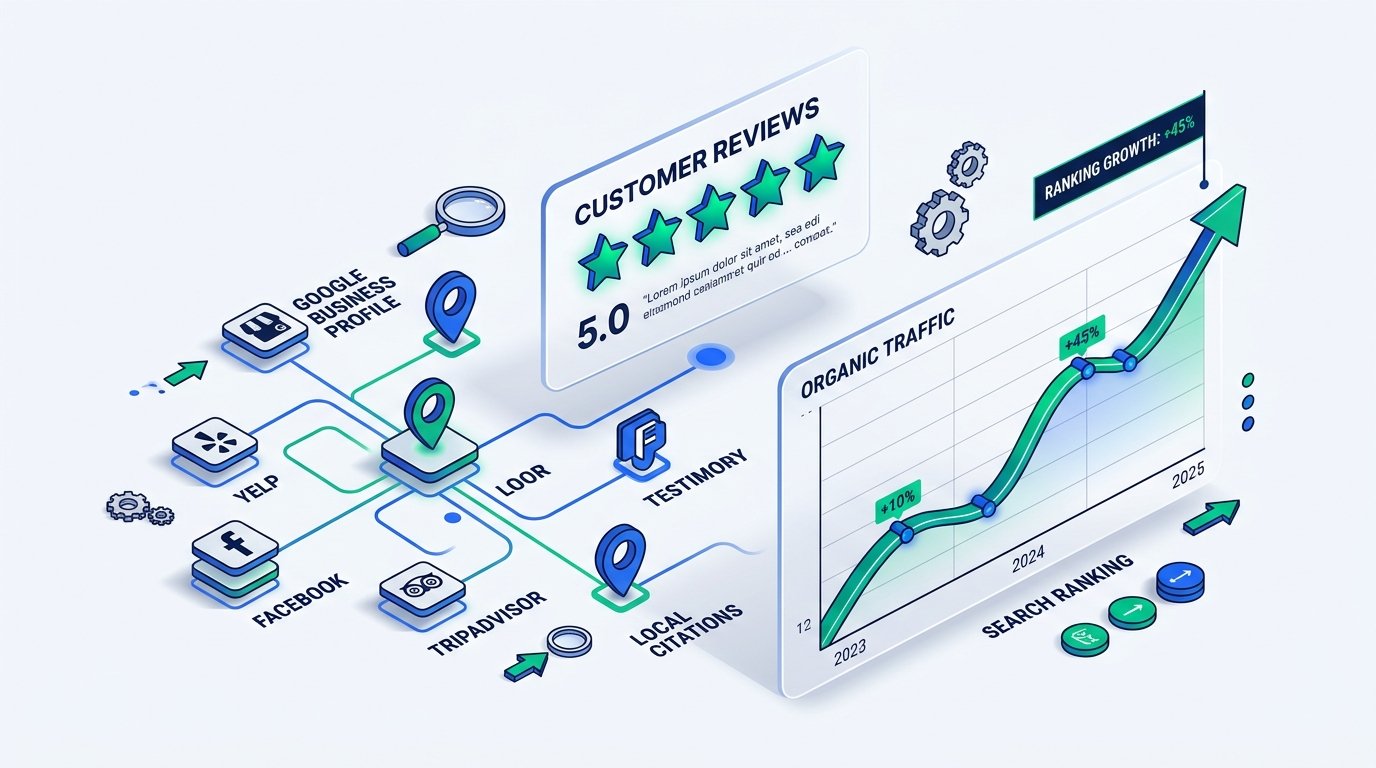
Reviews influence both rankings and real-world buyer decisions. Businesses with a steady flow of recent, detailed reviews typically earn higher click-through rates and more phone calls than competitors with outdated or scarce feedback.
Every strong local SEO checklist for small businesses treats review generation as an ongoing weekly habit rather than a one-time campaign.
Best Practices for Earning and Managing Reviews
- Ask right after a positive milestone: Send your direct Google review link via WhatsApp or email immediately after completing a project, delivery, or appointment.
- Keep the request simple: One polite message with a one-tap link gets far higher completion rates than long follow-up surveys.
- Respond to every single review: Thank happy customers warmly and address critical reviews calmly, professionally, and constructively.
- Never buy or fake reviews: Artificial review spikes violate platform policies, erode consumer trust, and can lead to profile penalties.
When satisfied customers naturally mention the service they bought and your neighbourhood in their review, it reinforces your relevance inside a local SEO checklist for small businesses without any artificial manipulation.
7. Implement LocalBusiness Schema Markup
Schema markup is structured JSON-LD code added to your website so search engines can read key business facts—such as your business name, opening hours, address, social profiles, and FAQs—without guesswork.
On WordPress websites, SEO plugins like Rank Math make adding LocalBusiness and FAQPage schema straightforward without manual coding. Make sure your schema details match the visible information on your website and Google Business Profile.
- Verify organization and local business fields: Include accurate business type, website URL, logo, contact information, and opening hours.
- Use FAQ schema on service and blog pages: Answer real buyer questions clearly to capture extra space in search results.
- Test your pages: Run key URLs through Google’s Rich Results Test after major template edits to confirm zero schema errors.
Structured data does not replace great content, yet it rounds out the technical side of a local SEO checklist for small businesses by ensuring search engines interpret your business information cleanly and accurately.
8. Improve Mobile Speed and User Experience
Most local searches happen on smartphones—often while a customer is commuting, comparing nearby options, or ready to call immediately. If your website takes five seconds to load or forces users to pinch and zoom, they will hit the back button and call the next listing.
That is why technical performance is non-negotiable in any modern local SEO checklist for small businesses. Check your homepage and top service pages using Google’s free PageSpeed Insights tool.
Quick Wins for Faster Mobile Performance
- Compress and resize images: Serve modern formats like WebP or properly sized PNG/JPEG files rather than multi-megabyte uploads.
- Minimize heavy scripts and unused plugins: Every extra script adds load time on mobile networks.
- Make contact buttons thumb-friendly: Ensure phone numbers are clickable (
tel:links) and forms ask only essential fields such as name, phone, and requirement. - Check layout stability: Prevent buttons or text from jumping around while the page finishes loading.
A fast, frictionless mobile site makes every other item in your local SEO checklist for small businesses perform better—increasing conversions not only from organic search, but also from paid campaigns like Google Ads and Meta Ads.
9. Earn Local Backlinks and Track Real Leads
Backlinks from credible local organizations signal to Google that your business is an established, trusted part of the community. At the same time, proper analytics ensures you measure real enquiries instead of guessing whether SEO is working.
Completing this final stage of our local SEO checklist for small businesses turns your SEO efforts into a measurable growth channel.
Ethical Ways to Build Local Authority Links
- Partner with complementary local businesses: For instance, a wedding photographer can collaborate on guides with local venues or florists.
- Join reputable local associations and events: Chambers of commerce, startup meetups, and community sponsorships often include member directory links.
- Publish genuinely useful local resources: Guides tailored to your region—such as our online growth guide for Delhi businesses—naturally attract citations and shares.
Metrics to Track Every Month
- Google Business Profile actions: Track website clicks, direction requests, and phone calls directly from your profile insights.
- Google Search Console queries: Monitor impressions, clicks, and average positions for your target local keywords.
- Google Analytics 4 conversions: Measure form submissions, WhatsApp clicks, and thank-you page visits from organic search traffic.
Common Local SEO Mistakes to Avoid
Even well-intentioned business owners sometimes stall their own rankings by falling into avoidable traps. Keep an eye out for these issues as you work through your local SEO checklist for small businesses:
- Creating fake virtual offices: Google increasingly verifies physical locations via video verification and suspends non-compliant addresses.
- Setting up SEO once and forgetting it: Competitors continually earn reviews and publish content; monthly maintenance protects your positions.
- Ignoring conversion optimization: Rankings alone do not grow revenue if visitors land on outdated pages with unclear offers.
How to Prioritize This Local SEO Checklist for Small Businesses
Working through an entire local SEO checklist for small businesses in a single weekend can feel overwhelming if you also manage staff, inventory, and daily customer calls. The smartest approach is to follow a staged rollout over four weeks.
- Week 1 (Visibility Foundation): Complete step 1 and step 2 of this local SEO checklist for small businesses by verifying your Google Business Profile and locking down consistent NAP details across your site and top directories.
- Week 2 (Search Intent & Pages): Complete step 3 and step 4 of the local SEO checklist for small businesses by mapping city-specific buyer keywords and publishing focused service landing pages.
- Week 3 (Technical & On-Page Polish): Apply step 5, step 7, and step 8 from the local SEO checklist for small businesses—tightening titles, meta descriptions, schema markup, and mobile speed.
- Week 4 and Ongoing (Authority & Trust): Turn step 6 and step 9 of this local SEO checklist for small businesses into a monthly rhythm of customer reviews, local partnerships, and conversion tracking.
When business owners execute this local SEO checklist for small businesses in clear weekly blocks, nothing gets left half-finished and measurable improvements show up faster.
How The MetaScale Helps Local Businesses Grow
At The MetaScale, we help startups and small businesses turn search visibility into measurable leads through practical SEO, performance marketing, and social media strategy. Rather than chasing vanity metrics, we focus on clean technical foundations, high-intent local content, and clear lead tracking.
If you want an experienced digital marketing agency in Delhi NCR to audit your current rankings, fix your Google Business Profile, and build a predictable local lead pipeline, contact The MetaScale today to discuss your goals.
Frequently Asked Questions About Local SEO
How long does a local SEO checklist for small businesses take to show results?
Most small businesses begin seeing improved Google Business Profile interactions and early keyword movement within 4 to 8 weeks after fixing technical and citation gaps, while competitive local rankings typically build stronger momentum over 3 to 6 months of consistent effort.
Do I need a physical storefront to use local SEO?
No. Service-area businesses such as plumbers, home tutors, consultants, and agencies can hide their street address on Google Business Profile while defining the specific cities or neighbourhoods they travel to serve.
What is the most important factor in a local SEO checklist for small businesses?
A properly categorized, active Google Business Profile paired with consistent NAP information, steady customer reviews, and dedicated local service pages forms the strongest foundation for both Maps and organic rankings.
Should small businesses invest in SEO or paid ads first?
Google Ads and Meta Ads can generate immediate enquiries while your organic presence is still growing, whereas local SEO builds long-term visibility that lowers your average cost per lead over time. Combining both often delivers the most balanced growth.
Conclusion
Ranking in local search is not about secret tricks—it is about executing the fundamentals more consistently than your competitors. By working through this local SEO checklist for small businesses step by step, you make it effortless for both Google and nearby customers to trust and contact your brand.
Start with your Google Business Profile and NAP audit this week, strengthen your service pages next, and turn customer reviews into a repeatable weekly habit. Revisit this local SEO checklist for small businesses once every quarter so your local visibility keeps compounding into steady calls, bookings, and long-term revenue.
